WEB MAGAZINE — VOL.6
Netflix / AI / 知識グラフ / 放送インフラ
Netflix / AI / Knowledge Graph / Broadcast Infrastructure
AIが理解できるシステムを、
あなたは持っているか?
Do You Have a System
That AI Can Truly Understand?
NetflixのKnowledge Graphが放送業界に突きつける問い
The Question Netflix's Knowledge Graph Poses to the Broadcast Industry
Netflix
Knowledge Graph
Agentic AI
Broadcasting
2026
Netflixの最新技術ブログを読んでいて、これは単なる運用ツールの話ではないと感じた。Netflixが発表した「Service Topology」は、一見するとサービス依存関係を可視化するマップだ。しかし本質はそこではない。彼らが構築しているのは、分散システム全体をリアルタイムで理解するための知識グラフ(Knowledge Graph)である。
Reading Netflix's latest engineering blog, I felt this was more than just an operations tool story. Netflix's "Service Topology" looks at first glance like a map visualizing service dependencies. But the real point is deeper. What they're building is a Knowledge Graph — a foundation for understanding the entire distributed system in real time.
Netflixが作ったのは「知識グラフ」基盤
Why Netflix Built a "Knowledge Graph" Foundation
Section 01
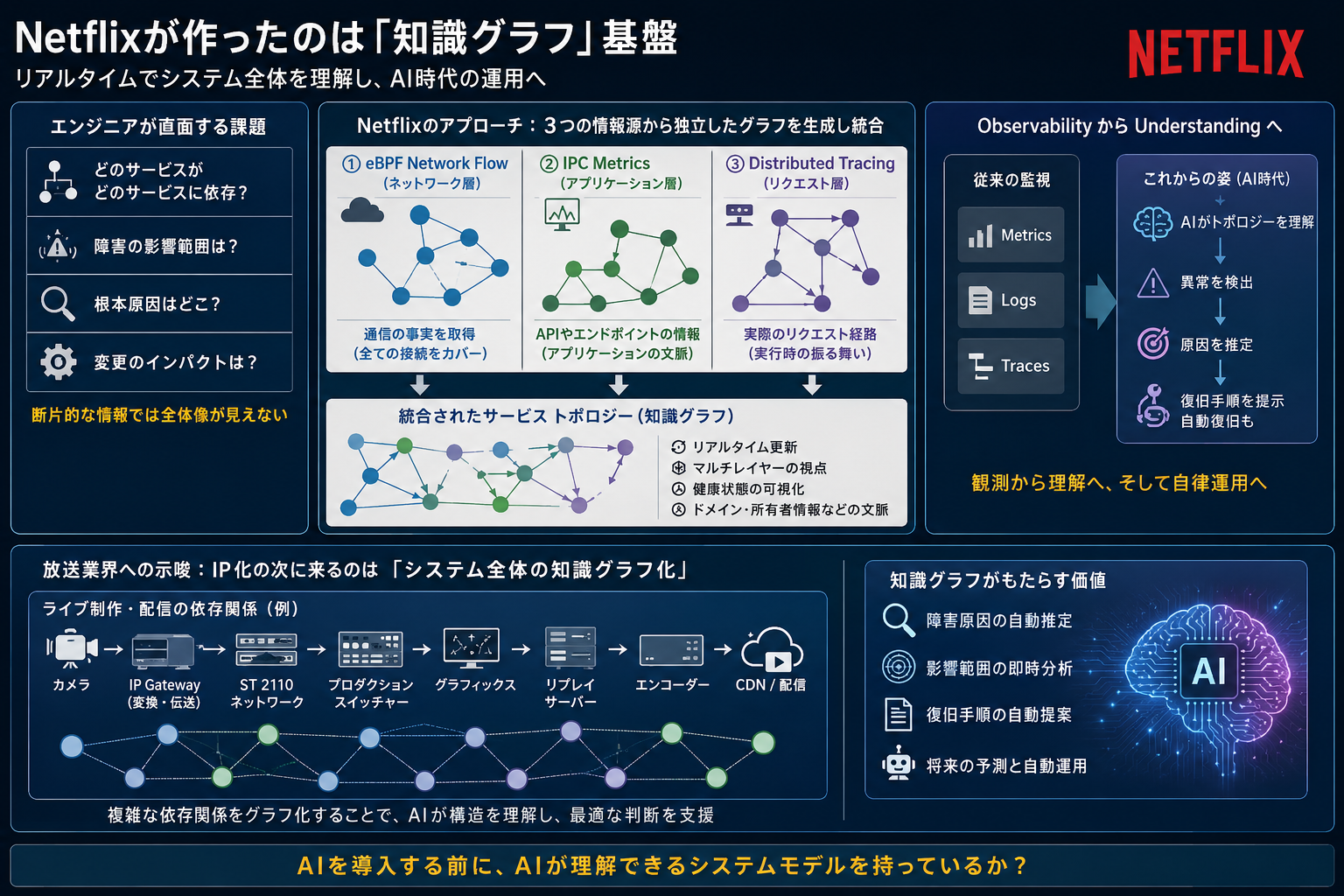
断片的な情報では、全体像は見えない
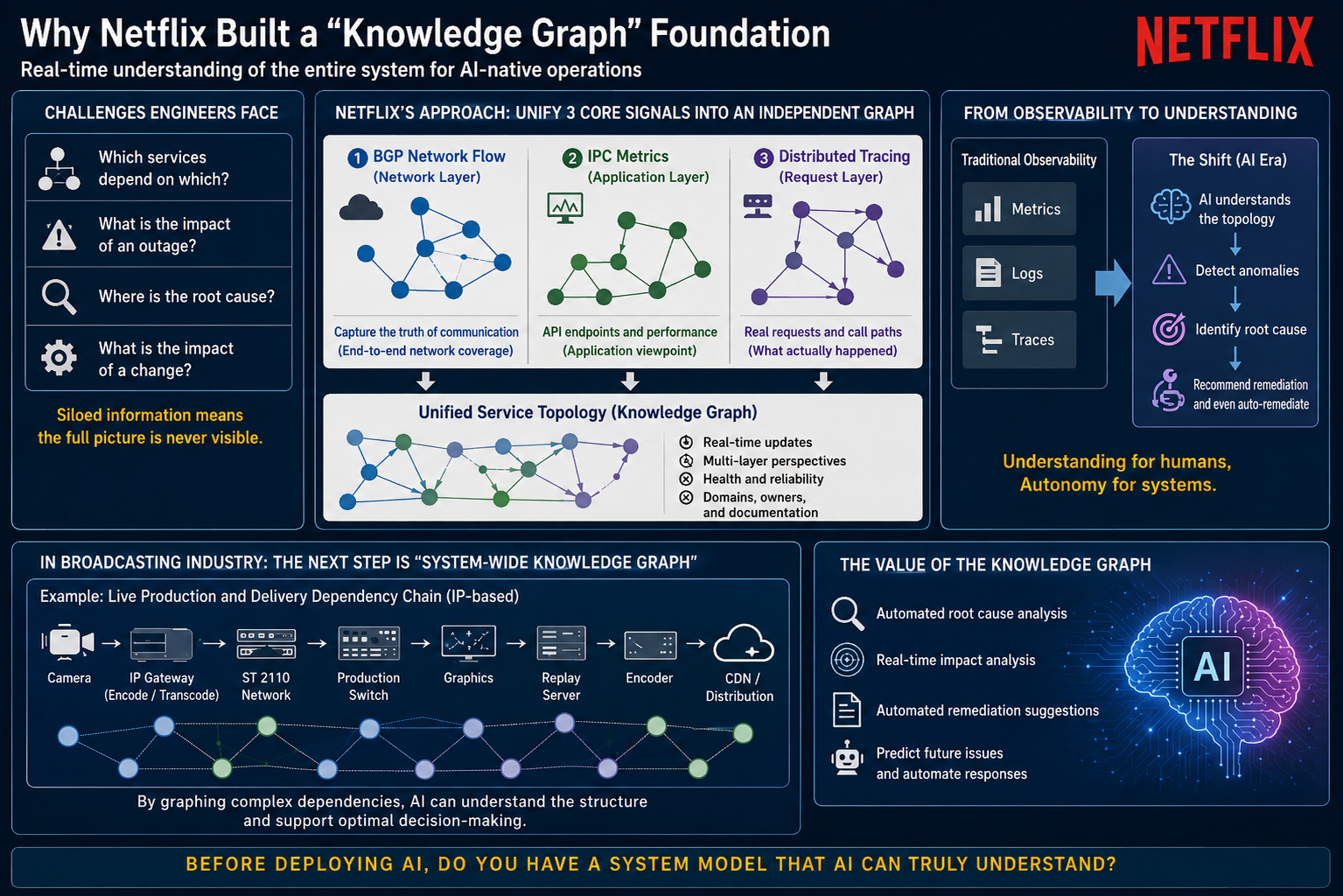
Siloed Information Means the Full Picture Is Never Visible
Netflixほどの規模になると、どのサービスがどのサービスに依存しているのか、障害の影響範囲はどこまで及ぶのか、根本原因はどこにあるのか――これらを人間が把握することは困難になる。
At Netflix's scale, it becomes impossible for humans to track which services depend on which, how far an outage's impact reaches, or where the root cause lies.
従来のObservability
Traditional Observability
Metrics(指標)
Logs(記録)
Traces(追跡)
Metrics
Logs
Traces
→ 断片的な情報
→ Siloed information
→
AI時代の理解
AI-Era Understanding
トポロジーを理解する
異常を検出する
原因を推定する
復旧を提示・自動実行
AI understands the topology
Detects anomalies
Identifies root cause
Recommends and auto-remediates
→ 観測から理解へ、自律運用へ
→ From observability to understanding to autonomy
Key
断片的な情報では、全体像は見えない。これが従来のObservabilityの限界であり、NetflixがKnowledge Graphを構築した理由だ。
Siloed information means the full picture is never visible. This is the fundamental limitation of traditional observability — and why Netflix built a Knowledge Graph.
Section 02
Netflixのアプローチ:3つの情報源を統合する知識グラフ
Netflix's Approach: A Knowledge Graph Unifying Three Data Sources
Netflixは以下の3つの情報源から独立したグラフを生成し、統合することで「システム全体の関係性」をリアルタイムに可視化している。
Netflix generates independent graphs from three data sources and integrates them to visualize the relationships across the entire system in real time.
01
eBPF Network Flow
ネットワーク層
Network Layer
通信の事実を取得。全ての接続をカバーし、ネットワーク上の依存関係を完全に把握する。
Captures the truth of communication. Covers all connections for complete visibility of network dependencies.
02
IPC Metrics
アプリケーション層
Application Layer
APIやエンドポイントの情報。アプリケーションの文脈でのサービス間通信を把握する。
API endpoints and performance data. Captures inter-service communication from the application's perspective.
03
Distributed Tracing
リクエスト層
Request Layer
実際のリクエスト経路と実行時の振る舞い。「実際に何が起きたか」を記録する。
Real request paths and runtime behavior. Records what actually happened during execution.
特に興味深いのは、監視データを単に保存するのではなく、サービス = ノード、依存関係 = エッジとしてGraph Databaseへ格納している点だ。これは「観測(Observability)」から「理解(Understanding)」へ移行しようとする試みだ。
What's particularly compelling is that rather than simply storing monitoring data, Netflix stores it in a Graph Database with services as nodes and dependencies as edges. This is a deliberate move from "observability" to "understanding."
Section 03
「観測」から「理解」へ、そして「自律運用」へ
From "Observability" to "Understanding" to "Autonomous Operations"
Netflixが作っているのは単なるトポロジーマップではない。Agentic AI時代の運用基盤そのものだ。
Netflix is not building a mere topology map. It is building the operational foundation for the Agentic AI era.
Point
観測から理解へ、そして自律運用へ。
人間のための理解、システムのための自律性。
Understanding for humans. Autonomy for systems.
From observability to understanding. From understanding to autonomous operations.
Understanding for humans. Autonomy for systems.
Section 04
放送業界への示唆:IP化の次に来るのは「知識グラフ化」
Implications for Broadcasting: After IP Migration Comes "Knowledge Graph Migration"
この考え方は放送業界にも直接当てはまる。ST 2110によるIP化、TAGなどによるリアルタイム監視――そしてその次に来るのは「システム全体の知識グラフ化」ではないだろうか。
This thinking applies directly to broadcasting. IP migration via ST 2110, real-time monitoring via TAG — and what comes next may be "system-wide knowledge graph migration."
ライブ制作・配信の依存関係(例)
Live Production and Delivery Dependency Chain (Example)
カメラ
Camera
→
IP Gateway
IP Gateway
→
ST 2110
→
スイッチャー
Production Switch
→
グラフィックス
Graphics
→
リプレイ
Replay
→
エンコーダー
Encoder
→
CDN
複雑な依存関係をグラフ化することで、AIが構造を理解し、最適な判断を支援する
By graphing complex dependencies, AI can understand the structure and support optimal decision-making
AIがこの構造を理解できるようになれば、以下が現実的になる。
When AI can understand this structure, the following become realistic.
- 障害原因の自動推定
- 影響範囲の即時分析
- 復旧手順の自動提案
- 将来の予測と自動運用
- Automated root cause analysis
- Real-time impact analysis
- Automated remediation suggestions
- Predictive and autonomous operations
Section 05
VOL.1からVOL.6へ:すべてが一本の線でつながる
From VOL.1 to VOL.6: Everything Connects in a Single Line
本誌VOL.3で論じたTrusted Media Intelligence Layerと接続すると、この知識グラフはまさにその「基盤層」に相当する。AIが組織知識を学習する前提として、まずシステム全体の構造をAIが理解できる形でモデル化することが必要なのだ。
Connecting this to the Trusted Media Intelligence Layer concept explored in VOL.3, the knowledge graph corresponds precisely to its "foundation layer." Before AI can learn organizational knowledge, the entire system structure must first be modeled in a form AI can understand.
VOL.1
AIをつなぐオーケストレーション
AI orchestration and integration
VOL.3
組織知能の継承・Trusted Media Intelligence Layer
Institutional knowledge · Trusted Media Intelligence Layer
VOL.4
意味的検索・コンテンツの理解
Semantic search · Content understanding
VOL.5
ワークフロー統合・AIネイティブ化
Workflow integration · AI-native transformation
VOL.6
AIが理解できるシステムモデル
System models AI can truly understand
→ 基盤
Knowledge Graph がすべてを支える
Knowledge Graph underpins everything
「AIをどう導入するかより先に、AIが理解できるシステムを持っているか。」
"Before asking how to deploy AI — do you have a system that AI can truly understand?"
多くの放送局・制作会社は今、「どのAIを導入するか」を議論している。しかしNetflixの事例が示すのは、その前に問うべきことがあるということだ。自社のシステムがAIにとって「理解可能な構造」になっているかを問うべきだ。知識グラフなき場所に、Agentic AIは根を張れない。
Most broadcasters and production companies are currently debating "which AI to deploy." But what Netflix's example shows is that there's a prior question to answer. Ask whether your systems are structured in a way that AI can truly understand. Without a knowledge graph, Agentic AI has no foundation to build on.
Netflixが構築しているのは、AI時代の運用インフラの雛形だ。放送業界において、IP化は「映像をデータとして扱う」基盤だった。次の段階は、「システム全体をAIが理解できる知識として扱う」基盤の構築だ。
What Netflix is building is a blueprint for operational infrastructure in the AI era. In broadcasting, IP migration created the foundation for "treating video as data." The next stage is building the foundation for "treating the entire system as knowledge that AI can understand."
Tags
#Netflix #Observability #ServiceTopology #KnowledgeGraph #AgenticAI #MediaTechnology #BroadcastEngineering #ST2110 #IPMX #TAGVideoSystems #MAM #DigitalTransformation
用語解説 / Glossary
Glossary
※1 Knowledge Graph(知識グラフ) — ノード(実体)とエッジ(関係)でデータを表現するデータベース構造。データ間の「関係性」を構造化して格納することで、AIが文脈を理解しやすくなる。
※1 Knowledge Graph — A database structure representing data as nodes (entities) and edges (relationships). By structuring "relationships" between data, it enables AI to understand context more effectively.
※2 Observability(可観測性) — システムの内部状態を外部から観測できる度合い。Metrics・Logs・Tracesの3要素で構成される。近年はこれだけでは不十分として「Understanding(理解)」への移行が議論されている。
※2 Observability — The degree to which a system's internal state can be observed from the outside. Composed of three elements: Metrics, Logs, and Traces. Recently, moving beyond observability to "Understanding" has been increasingly discussed.
※3 eBPF(extended Berkeley Packet Filter) — Linuxカーネル内で安全にプログラムを実行できる技術。ネットワークトラフィックやシステムコールをリアルタイムに取得できる。Netflixはこれでネットワーク層の通信を全捕捉している。
※3 eBPF (extended Berkeley Packet Filter) — Technology enabling safe program execution inside the Linux kernel. Enables real-time capture of network traffic and system calls. Netflix uses this to capture all network-layer communications.
※4 Distributed Tracing(分散トレーシング) — マイクロサービス環境で、一つのリクエストが複数のサービスをまたがる際の経路を追跡する技術。「実際に何が起きたか」を記録する。
※4 Distributed Tracing — Technology for tracking the path of a single request across multiple services in a microservices environment. Records "what actually happened."
※5 Agentic AI — 人間の指示を待たず、自律的に判断・実行・改善を繰り返すAI。単なる回答生成AIと異なり、ツール操作・タスク実行・環境への働きかけができる。VOL.1のAgent概念の発展形。
※5 Agentic AI — AI that autonomously judges, executes, and iterates without waiting for human instructions. Unlike simple response-generation AI, it can operate tools, execute tasks, and act on its environment. An evolution of the Agent concept introduced in VOL.1.
※6 ST 2110 — 映像・音声・データを別々のIPパケットとして送受信するための国際標準規格。VOL.3で詳述。
※6 ST 2110 — International standard for sending video, audio, and data as separate IP packets. Detailed in VOL.3.
※7 TAGビデオシステムズ — 放送向けリアルタイム監視ソリューションのベンダー。IP放送環境での信号品質監視・プローブ管理などを提供。
※7 TAG Video Systems — Vendor of real-time monitoring solutions for broadcasting. Provides signal quality monitoring and probe management in IP broadcast environments.
Liner Notes Consulting — Web Magazine Vol.6 — 2026